In the fire service we are required to know the function and use of a plethora of tools and equipment. We are also required to use them in austere environments, under low light conditions, high heat areas, on rooftops, and in ditches. Often times we train with our tools in relatively difficult situations, therefore building our confidence that we can operate better on a real scene. But how often do we train on the tools we use everyday with the non-dominant hand?
There is something that happens to people when they are forced to do an everyday task with there lesser hand, some sort of disconnect occurs turning Dr.Jeckyll into some sort of cross eyed Mr.Hyde. We throw footballs straight into the dirt, write like a 4 year old, and swing a bat like were having a seizure. Sounds a little bit like some guys on scene...
When I was a kid my left eye began to shut down and my right eye took over. I started off life as an everything left hander but when my eye failed I was forced to learn most tasks right handed due to the fact that I had better vision on that side. I have since regained most vision in that eye but that ordeal left me in a sort of ambidextrous state. Writing, drawing, and eating left handed but shooting, throwing, and sports right handed. Go figure. However my condition is not common and most people are not able to do even one thing with the opposite hand.
Heres the problem and how it relates to the fire service. Say were on a roof to vent and the only possible hole location forces you to switch to your lesser side. Do you feel comfortable operating a saw on a roof with say your left hand? What about an auto extrication? We all know about pinch points and how you never want to put yourself between the tool and the car. However, on occasion this can only be truly successful if we switch hands and change our stance. We just got a new rig at my station with the ladders stored inside, however the 24' extension is placed in such a way that to pull it out feet forward and "bed to head" you have to carry it on your left shoulder. I know for me even being left handed carrying and throwing a ladder on my left side is incredibly awkward.
There are a few simple ways to begin training yourself to be more comfortable working with your lesser hand. Small ways to start would be eating with said hand. This begins to train your hand/eye coordination in a controlled atmosphere, just maybe dont do this at the firehouse, you may look a tad ridiculous at first. One of the ways to practice when youre at work is when checking off the truck in the morning try all your check offs with the lesser hand. If you carry saws on the rig, set the choke and pull start it with the lesser hand. Pick it up and run it up while holding it the opposite way. Youll be surprised how uncomfortable you are with the torque of a K-12 when you arent using your dominant hand any longer. Even the extrication tools are good to train with, hook them up and open and close them then same way you would usually but exchange hand positions without setting them down. Also when you get out and pull lines, try placing them on the opposite shoulder and operating the nozzles backwards from usual. One thing I do when working out is sledgehammer strikes on a tractor tire, but I switch up the stance and hand grip I use to really perfect my swing no matter what side im on.
Once you get the swing of things try putting yourself in legitimate training scenarios in gear and operate the way you would just with the other hand. Get on some roof props and cut some holes with an axe and saws switching up your grip and stance.
These things may be uncomfortable and awkward at first but constant training with the lesser hand will only make you more of a master of your craft and give you the confidence to know you can handle the tools of the trade no matter the position you are in. Not to mention giving yourself the ability to work with both hands essentially doubles your working ability and only improves your safety and the safety of those around you.
Remember the fire doesnt care where you are or if you are comfortable swinging an axe on your other side. The only way to build confidence is to practice ambidextrous operations in the everyday simple tasks. Get out and train and encourage others to do the same.

Thursday, March 6, 2014

Tuesday, January 7, 2014
Tire tube helmet bands
So incase you havent noticed, Im the kind of guy who likes to make things myself. Not sure if I get it from my upbringing or the fact that im on a firemans salary and cant always afford to buy commercially made items, and I dont really see the sense in buying something I can make myself. The latest thing i've made around the house is a few helmet bands made from the tube of a tractor trailer tire. I figured i would include a few pictures of the process so you can give it a shot yourself. Or message me and ill mail you one of these.


First youll need to find a tube from a tractor trailer tire...Good luck. I asked around a few shops until I found someone who actually had one in their garage. But still any shop that does these tire changes is bound to have one or two blown tubes laying around.
The second thing youll need is a solid pair of scissors, I used a pair of North American Rescue trauma shears. In my opinion these are the best shears out there. Buy your own pair here.
Find a ruler and mark out your lines at the desired width. Making sure to line up one end even. If you try and cut with the curve youll end up with something you dont want...trust me.
You lose alot of material this way but you get a straight cut.
You can only make a few at a time before your hand cramps up. But with a little help and some ingenuity you can make enough bands for your firehouse and then some.
Not to mention, they kind of have a cool design to them...
Wednesday, January 1, 2014
2014 Perfection

I was reading this article on turnoutblog.com about the soldiers at the tomb of the unknown soldier, and it got me thinking. It got me thinking about the new year, where I have been, where I plan on going, training, goals, etc. But mostly had me thinking about training and how it relates to my job.
If you havent looked into what it takes to be a guard at the tomb of the unknown solider, I would recommend taking the time to do so. It made me really desire to visit the tomb one day and view first hand the changing of the guards.
There are so many lessons one can take away from the guards here, especially as it relates to the fire service. These guys are masters of their craft. They know the job inside and out, it means everything to them and they strive for perfection. Now we all know perfection cannot be achieved, as we see in the article I posted above, where one of the guards failed inspection. But this is one mistake out of tens and maybe hundreds of thousands of changeovers over the past 92 years. Have there been others? Sure, but they are so rare they are almost mythical.
These guys commit their lives to this job, they commit everything they have to those 21 steps, those 21 seconds, and the changing of the guards presentation. They perfected it. Fewer than twenty percent of volunteers are chosen and only a fraction of those actually pass the rigorous training required to be a sentinel.
When it comes to our job, we train, we get dirty, we go back, shower up and rest. Are we actually "mastering" anything in that? Now I understand our job entails many more functions than the sentinels have to deal with while on guard, but what if we treated our riding position as our very own guard mat? What if we took the handful of functions we are required to know for our seat on a first due fire and strived to perfect them? Is that possible? No, because our job is ever changing and fires are never the same, but if we aimed to perfect a few specific tasks it would be safe to say we would become pretty dang good at it. Not perfect, but excellent. Just as the sentinels, while they appear so, arent perfect but have mastered the job they are expected to do.
If we put the time and effort this next year to mastering our craft as it relates to our riding position (while still keeping fresh on everything else), We could have an impact on the crew around us. And if one whole crew was striving to master the craft of their apparatus imagine the effect on scene it would have on a whole battalion, and if a battalion was striving...well...you get the point!
Just as only a few percent of soldiers make the cut to be a sentinel, so are there a few percent of firemen who are sold out to the job. But it starts with the few percent. Be a virus, infect the others with passion!
Always remember, we arent perfect, were human. We will never know it all, and when we think we do its time to go home.
"We will be relentless in our pursuit of perfection. We wont ever be perfect - but in the process we will achieve greatness." -Vince Lombardi

Thursday, December 26, 2013
Through the lock Channelocks
So the "through the lock" channel-locks have been around for some time now. With several slight variations to each handmade pair. All with the same purpose in mind, and that is to act as a set of pliers and at the same time acting as a key tool.
For my pair of pliers, I went the more fireman budget friendly route and recycled an old pair of pliers my grandpa had in his junkyard. Not only was I able to recycle an old tool and give it new life, but it means something more to me knowing my hero busted his knuckles with these pliers at some point in his life.
Most guys are getting the Channel lock brand because they are known for their durability and stout design. However I believe any pair will work. One word of advice though, and that is to measure your bunker pockets before getting yourself a pair. My set is rather long and I have a tough time fitting them in my pocket.
To make your own pair I would recommend following this step by step walkthrough from the guys at ironsandladders.com
I didnt follow the guide exactly but im quite content with the outcome. Especially considering the pliers themselves wouldnt even open when I first found them. When making mine I ground the tip down until it successfully manipulated the lock on my good friend Dave Werners' Through the lock prop
I finished my pair off with a spiral weave wrap of friction tape to increase grip when breaking the cylinder loose.
For a quick video demonstrating how these pliers are used check out this video from Nick Martin Pliers in use
Having a set of these pliers is a great addition to any set of bunker gear. It allows entry to storefronts with Adams Rite style locks while avoiding breaking large amounts of glass and creating excess ventilation areas. Also for alarms with no key or keyholder present the lock can be locked back and the cylinder screwed back in as a temporary fix.


For my pair of pliers, I went the more fireman budget friendly route and recycled an old pair of pliers my grandpa had in his junkyard. Not only was I able to recycle an old tool and give it new life, but it means something more to me knowing my hero busted his knuckles with these pliers at some point in his life.
Most guys are getting the Channel lock brand because they are known for their durability and stout design. However I believe any pair will work. One word of advice though, and that is to measure your bunker pockets before getting yourself a pair. My set is rather long and I have a tough time fitting them in my pocket.
To make your own pair I would recommend following this step by step walkthrough from the guys at ironsandladders.com
I didnt follow the guide exactly but im quite content with the outcome. Especially considering the pliers themselves wouldnt even open when I first found them. When making mine I ground the tip down until it successfully manipulated the lock on my good friend Dave Werners' Through the lock prop
I finished my pair off with a spiral weave wrap of friction tape to increase grip when breaking the cylinder loose.
For a quick video demonstrating how these pliers are used check out this video from Nick Martin Pliers in use
Having a set of these pliers is a great addition to any set of bunker gear. It allows entry to storefronts with Adams Rite style locks while avoiding breaking large amounts of glass and creating excess ventilation areas. Also for alarms with no key or keyholder present the lock can be locked back and the cylinder screwed back in as a temporary fix.

The pliers when I first found them were so rusted they wouldnt even open. After a liberal soaking in WD-40, a little elbow grease and steel wool, they operate good as new.

Saturday, December 21, 2013
Homemade door chocks
Door chocks are one of those items every firefighter needs to have on them, and more than one for that matter. I try and carry a few door chocks, cherry bomb style chocks, and two clamps...all with the same purpose, to hold various style doors open at any given time. However the basic wooden door chock is good for so much more, from vehicle extrication, gapping doors, and aiding in various forcible entry methods.
Being a fireman on a firemans salary, I try and make something myself before I go off and buy it. This always saves me money and also instills a little pride in what it is you now will carry.
For Christmas this year, I stopped by The Home Depot and picked up a scrap 2x4 for .80 cents, took it home, and with a few rough cuts of a skil saw, a piece of plastic made into a crude stencil, and some spray paint, I had enough door chocks for all three shifts to have 2 chocks a piece. Or 6 a piece if my shift is feeling greedy.
With thefirestore.com selling door chocks ranging in price from $2 to $15 a piece, all doing the same purpose, it just made sense to get my hands dirty and make 24 personalized chocks for about 3 cents a piece.
What are you making around the firehouse or at home today?
Merry Christmas from Priority Firefighting!
.JPG)
Being a fireman on a firemans salary, I try and make something myself before I go off and buy it. This always saves me money and also instills a little pride in what it is you now will carry.
For Christmas this year, I stopped by The Home Depot and picked up a scrap 2x4 for .80 cents, took it home, and with a few rough cuts of a skil saw, a piece of plastic made into a crude stencil, and some spray paint, I had enough door chocks for all three shifts to have 2 chocks a piece. Or 6 a piece if my shift is feeling greedy.
With thefirestore.com selling door chocks ranging in price from $2 to $15 a piece, all doing the same purpose, it just made sense to get my hands dirty and make 24 personalized chocks for about 3 cents a piece.
What are you making around the firehouse or at home today?
Merry Christmas from Priority Firefighting!
.JPG)
Friday, December 20, 2013
New tool wrap
Now we all know theres a thousand and one ways to wrap our tools out there. Everybody has a preference be it wrapped or unwrapped. Personally I prefer my tools wrapped, and I use a hockey style black friction tape, however after a little firehouse ingenuity my shift came up with a new way to wrap tools, well lets say a new material to wrap them in.
We had a roll of 3M High performance pavement marking tape lying around, primarily used for striping highways improving night-time visibility and wet road traction. Well as we all know Firemen always find second, third, fourth, and so on uses for almost anything. After a little deliberation we decided to try and wrap some tools and discovered we loved it as tool wrap.
The tape is designed to stick to asphalt with no prep work so its extremely adhesive, and really felt like it was going to stay put. It has raised squares that have a very rough feel to them but with gloves really has a solid grip. Also it is designed for visibility on the highway so with any light on it the tape really shines. Not to mention 3M gives it an 8 year life expectancy with highway driving, so its safe to say it will last 2 years in the hands of firemen. But seriously, this tape is tough.
The looks might not be for everyone, but finding a new use for something that actually works is always worth sharing.
If you have any new ways to wrap your tools feel free to share them!


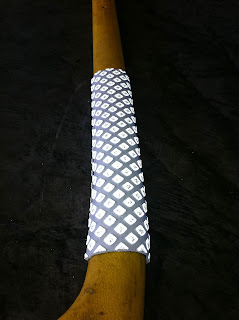
We had a roll of 3M High performance pavement marking tape lying around, primarily used for striping highways improving night-time visibility and wet road traction. Well as we all know Firemen always find second, third, fourth, and so on uses for almost anything. After a little deliberation we decided to try and wrap some tools and discovered we loved it as tool wrap.
The tape is designed to stick to asphalt with no prep work so its extremely adhesive, and really felt like it was going to stay put. It has raised squares that have a very rough feel to them but with gloves really has a solid grip. Also it is designed for visibility on the highway so with any light on it the tape really shines. Not to mention 3M gives it an 8 year life expectancy with highway driving, so its safe to say it will last 2 years in the hands of firemen. But seriously, this tape is tough.
The looks might not be for everyone, but finding a new use for something that actually works is always worth sharing.
If you have any new ways to wrap your tools feel free to share them!


Wednesday, December 11, 2013
Heat stroke LODDs in training and one personal near miss...
This blog has been on a standstill, due to two reasons. The main reason is i was very involved in school and the other being during school, i was recovering from a severe heat stroke i suffered in late august. I wasnt planning on writing about it, and i only will to an extent, due to personal feelings surrounding the incident itself regarding events leading up to it. However i saw this article today on firefighter nation and felt an immense connection with Captain Smith.
In late august of 2013, the temperatures were averaging 90-100 degrees on the South Carolina coast with a heat index exceeding far beyond that. I was involved in an intense training regiment similar to that of Captain Smith when during a morning run i suffered a heat stroke and became unresponsive. For two days prior I had been in a state of heat exhaustion but continued to push through the training, in fear of losing my job, despite becoming ill secondary to the heat exhaustion. Water breaks were scarce and not at all readily available as the media made others believe. Full PPE worn all day along with non stop exercise in the heat had already caused several others to fall out and be transported for evaluation.
During the run, i dont remember much, what i do remember is telling my partner that something was wrong, and i noticed my respirations change to wheezing. Thats the last thing i recall. I collapsed 100 yards from the finish and I was immediately carried to the training facility and iced down by my peers (this is later learned from the ER physician was a major contributing factor that saved my life), then rapidly transported to the ER, where along the way became extremely combative, striking the ambulance crew and ripping out my IVs. I slipped back into an unconscious state and awoke roughly 3 hours later in the ER and had no ability to speak. I could think but not speak.
My temperature in the ER after rapid cooling, A/C, and two large bore IVs with cold fluids was 107 F. Doctors say i was most likely closer to 110 F at the time i collapsed. Far beyond the threshold for survival. All for what? Better training? I disagree...
Now this brings me to several incidents, all similar to mine
On May 19th, 2005, a 22 year old male career fire recruit collapsed during a class run, slipping into a coma with a temperature around 108 F and perished over a week later. This young man died on a 3 mile run, again for what? Someone please tell me...
You can read the NIOSH report here:
Florida recruit heatstroke NIOSH report
On April 20th, 2009, a 26 year old recruit suffers a heat stroke, begins to recover, suffers organ failure due to rhabdomyolosis, is put on life support and passes away days later.
Read the report here:
Texas recruit heatstroke NIOSH report
And again on September 16th, 2012 a four year veteran Fire Captain has a heatstroke during a smoke divers training program, goes into cardiac arrest with a temperature of 107.9, and never recovers.
Read the report here:
Texas captan heatstroke report
And the Firefighter nation article here:
Firefighter nation article
When i look at these incidents, i see three (almost four) deaths of our brothers directly due to training. Now i am all for intense, real world, training. But when we are killing our own, shouldnt we take a step back and figure things out? If we are in a situation where we are training in conditions to hot to stay safe arent we defeating the purpose? We go into a hot environment and as quickly as we can cool it down with suppression and ventilation. We come out and hopefully go to an established rehab per NFPA 1584 and OSHA 29 CFR 1910.120 requirement 1910.120(g)(5)(x), to cool down and rest after at most 30 minutes of strenuous activity. So why then, are we pushing our bodies (or having our bodies pushed) to the point of death for hours and hours on end? Tell me i am not alone in thinking this is lunacy? Not to mention, when we begin to hit the stage of heat exhaustion i can assure you, you arent learning anything new, you have flipped the switch from beneficial training to sheer survival.
The name of this blog is priority firefighting. Following the three firefighter priorities: Life safety, Incident stabilization, and Property conservation. Life safety refers to: Our safety, our crews safety, and then the citizens safety. To push others to the limit where life safety is in jeopardy is not only going against the grain of what we stand for but in some cases could and should be pursued in a criminal manner.
Our safety in these training evolutions falls in what i believe to be three hands: Yours, your instructors, and your peers.
Obviously you should keep yourself safe and as hydrated as possible, rumors surrounding my incident claimed i was "hopped up on energy drinks" and "not drinking enough water". Both of which are untrue. Hydration is of paramount importance and should not be taken lightly. If you arent feeling yourself and you honestly feel like something is wrong, something most likely is and you ned to act quickly.Your safety secondly falls in the hands of the instructors, training is great, but killing people to do so is the most asinine thing i can think of. Refusing water to students, and blatant disregard for heat index regulations is something that cannot be overlooked. Lastly your peers have somewhat of a responsibility. If you see one of your own with any of the signs or symptoms of heat exhaustion, make sure you take action before it progresses to heat stroke. As first responders we arent limited to the people that call 911, we are responsible for the ones around us. Preventing an injury is much better than having one occur that could have been stopped. These brothers gave their lives and you dont hear much about heat regulation in fire training. Why? Most likely because admitting heat illness as a fireman is a demeaning sign of weakness...but is it really? If we take precautions in the field, why dont we do the same to make sure we make it to the field?
In late august of 2013, the temperatures were averaging 90-100 degrees on the South Carolina coast with a heat index exceeding far beyond that. I was involved in an intense training regiment similar to that of Captain Smith when during a morning run i suffered a heat stroke and became unresponsive. For two days prior I had been in a state of heat exhaustion but continued to push through the training, in fear of losing my job, despite becoming ill secondary to the heat exhaustion. Water breaks were scarce and not at all readily available as the media made others believe. Full PPE worn all day along with non stop exercise in the heat had already caused several others to fall out and be transported for evaluation.
During the run, i dont remember much, what i do remember is telling my partner that something was wrong, and i noticed my respirations change to wheezing. Thats the last thing i recall. I collapsed 100 yards from the finish and I was immediately carried to the training facility and iced down by my peers (this is later learned from the ER physician was a major contributing factor that saved my life), then rapidly transported to the ER, where along the way became extremely combative, striking the ambulance crew and ripping out my IVs. I slipped back into an unconscious state and awoke roughly 3 hours later in the ER and had no ability to speak. I could think but not speak.
My temperature in the ER after rapid cooling, A/C, and two large bore IVs with cold fluids was 107 F. Doctors say i was most likely closer to 110 F at the time i collapsed. Far beyond the threshold for survival. All for what? Better training? I disagree...
Now this brings me to several incidents, all similar to mine
On May 19th, 2005, a 22 year old male career fire recruit collapsed during a class run, slipping into a coma with a temperature around 108 F and perished over a week later. This young man died on a 3 mile run, again for what? Someone please tell me...
You can read the NIOSH report here:
Florida recruit heatstroke NIOSH report
On April 20th, 2009, a 26 year old recruit suffers a heat stroke, begins to recover, suffers organ failure due to rhabdomyolosis, is put on life support and passes away days later.
Read the report here:
Texas recruit heatstroke NIOSH report
And again on September 16th, 2012 a four year veteran Fire Captain has a heatstroke during a smoke divers training program, goes into cardiac arrest with a temperature of 107.9, and never recovers.
Read the report here:
Texas captan heatstroke report
And the Firefighter nation article here:
Firefighter nation article
When i look at these incidents, i see three (almost four) deaths of our brothers directly due to training. Now i am all for intense, real world, training. But when we are killing our own, shouldnt we take a step back and figure things out? If we are in a situation where we are training in conditions to hot to stay safe arent we defeating the purpose? We go into a hot environment and as quickly as we can cool it down with suppression and ventilation. We come out and hopefully go to an established rehab per NFPA 1584 and OSHA 29 CFR 1910.120 requirement 1910.120(g)(5)(x), to cool down and rest after at most 30 minutes of strenuous activity. So why then, are we pushing our bodies (or having our bodies pushed) to the point of death for hours and hours on end? Tell me i am not alone in thinking this is lunacy? Not to mention, when we begin to hit the stage of heat exhaustion i can assure you, you arent learning anything new, you have flipped the switch from beneficial training to sheer survival.
The name of this blog is priority firefighting. Following the three firefighter priorities: Life safety, Incident stabilization, and Property conservation. Life safety refers to: Our safety, our crews safety, and then the citizens safety. To push others to the limit where life safety is in jeopardy is not only going against the grain of what we stand for but in some cases could and should be pursued in a criminal manner.
Our safety in these training evolutions falls in what i believe to be three hands: Yours, your instructors, and your peers.
Obviously you should keep yourself safe and as hydrated as possible, rumors surrounding my incident claimed i was "hopped up on energy drinks" and "not drinking enough water". Both of which are untrue. Hydration is of paramount importance and should not be taken lightly. If you arent feeling yourself and you honestly feel like something is wrong, something most likely is and you ned to act quickly.Your safety secondly falls in the hands of the instructors, training is great, but killing people to do so is the most asinine thing i can think of. Refusing water to students, and blatant disregard for heat index regulations is something that cannot be overlooked. Lastly your peers have somewhat of a responsibility. If you see one of your own with any of the signs or symptoms of heat exhaustion, make sure you take action before it progresses to heat stroke. As first responders we arent limited to the people that call 911, we are responsible for the ones around us. Preventing an injury is much better than having one occur that could have been stopped. These brothers gave their lives and you dont hear much about heat regulation in fire training. Why? Most likely because admitting heat illness as a fireman is a demeaning sign of weakness...but is it really? If we take precautions in the field, why dont we do the same to make sure we make it to the field?
Monday, December 9, 2013
NIOSH 5 part 2 - Lack of command
NIOSH top 5, number 2...
Lack of incident command.
Having been on the job for a few short years, ive worked for now 3 career fire departments (and dont plan on adding any more). With these 3 departments ive also worked alongside several other departments through the means of mutual aid, Some were bigger and some were smaller, but all of them did fireground command different. Why?
The department i currently work for has an excellent command structure and have revamped their system emphasizing the crucial need for an experienced, trained, and dedicated Incident commander. Previously i have been on fires where there was no command at all, and some where the word "command" was thrown around so loosely well just say there wasnt.
Now obviously every place has their reasons as to why a designated commander isnt utilized, mostly the reason boils down to manpower. Something many places are dealing with. But with this being the number two killer wouldnt we want to focus a little more attention on it?
Now i by no means am qualified to be an incident commander, im just writing what i see and what i know. i am finding this part difficult to compose because of my current position.
I cannot sit here and tell you how to be an effective commander, i can however layout some basic command information and the benefits thereof, in hopes that you can take it to somewhere that struggles with the belief that "we arent big enough to use command" or "we dont run enough fires for that".
If your department utilizes command then by all means refer to departmental SOGs.
Below is an excerpt (with adjustments) from an SOG draft i composed for a previous department:
Lack of incident command.
Having been on the job for a few short years, ive worked for now 3 career fire departments (and dont plan on adding any more). With these 3 departments ive also worked alongside several other departments through the means of mutual aid, Some were bigger and some were smaller, but all of them did fireground command different. Why?
The department i currently work for has an excellent command structure and have revamped their system emphasizing the crucial need for an experienced, trained, and dedicated Incident commander. Previously i have been on fires where there was no command at all, and some where the word "command" was thrown around so loosely well just say there wasnt.
Now obviously every place has their reasons as to why a designated commander isnt utilized, mostly the reason boils down to manpower. Something many places are dealing with. But with this being the number two killer wouldnt we want to focus a little more attention on it?
Now i by no means am qualified to be an incident commander, im just writing what i see and what i know. i am finding this part difficult to compose because of my current position.
I cannot sit here and tell you how to be an effective commander, i can however layout some basic command information and the benefits thereof, in hopes that you can take it to somewhere that struggles with the belief that "we arent big enough to use command" or "we dont run enough fires for that".
If your department utilizes command then by all means refer to departmental SOGs.
Below is an excerpt (with adjustments) from an SOG draft i composed for a previous department:
If we hope to reduce the number of firefighter LODD’s on the fireground, we must command fires in a way that evolves around all five of the NIOSH 5 factors.
Every fire deserves our respect, and each fire presents unique challenges. That being said, we must have a consistent and systematic way to approach these fires if we hope to consistently run an effective incident. That’s the reason SOG’s are so important and the lack of SOGs or not following them is number 5 on the NIOSH list. With that being said, no system will replace astute fire officers who know their job.
-Responsibilities of IC
Upon arrival of the first commanding officer, command will be established, this will be known as Initial command, if the officer decides or is forced to remain in a command mode for the duration of the incident, he know becomes Continuing command.
The responsibilities of initial command will be:
- Assume an effective command position.
- Transmit a brief initial radio report.
- Rapidly evaluate situation (size-up).
- Develop a plan of attack.
- Assign units as required.
The responsibilities of continuing command will be:
- Provide continuing overall command and progress reports for the duration or until relieved by a ranking officer.
- Assign Sectors if necessary and manpower allows
- Review and evaluate attack efforts and revise plan of attack as needed.
- Requests and assign additional unit as necessary.
- Maintain crew member accountability.
- Return companies to service and terminate "command"
Now breaking down those two types of command further we have three other types of command generally established by the first arriving officer:
-Types of command modes
Nothing showing mode
This is a situation where upon arrival, no immediate actions are required to mitigate a situation. In this situation the first arriving officer will call command but will make entry to investigate the situation while reducing response and staging incoming units. This sometimes is referred to as investigative mode.
Fast attack mode
In situations, which would require immediate action to stabilize an incident or to save viable life, such as occupied residences or businesses, the company officer may have to decide how to commit his company and be involved. When a fast interior attack is critical to life safety, he may take advantage of his portable radio to manage his crew from either interior (dependant on the situation), or be a very mobile and engaged command. This mode should not last more than a few minutes and should end with one of the following:
- The situation is stabilized
- Command is passed off to the next arriving officer
- Situation is not quickly stabilized and the officer must retreat to a normal command position.
Command mode
Situations that require designated initial command immediately. Such situations that by virtue of the size of the fire, the complexity/potential of the occupancy, or the possibility of extension require strong, direct, and overall command from the outside. In such cases, the officer will initially assume a Command position and maintain that position until he is relieved by another ranking officer.
-Benefits of a designated IC
-It improves accountability. The number three killer of fire fighters on scene is lack of accountability. The main way accountability will be improved is by having someone literally accounting for all personnel. The easiest way to maintain this, once IC is established is by utilizing PAR (personnel accountability report). This basic system allows command to keep a log of who is where on what assignment and allows for an accurate and rapid implementation of a RIT team if a MAYDAY was transmitted. PAR roll calls may be transmitted at any of the following times:
- Any report of a missing or trapped fire fighter
- Any time a Mayday is called
- Any change from offensive to defensive
- Any sudden hazardous event at the incident, i.e: flashover, backdraft, structural collapse, etc.
- At every 30 minutes of elapsed time
- At a report of fire under control
- Any time an “Abandon” order is given.
- Any time Command feels it is necessary
A company specific PAR should also be given any time a company is performing a specific operation. For example:
Command, Engine 1
Engine 1, go ahead
Command, Engine 1 entering A side of structure on fire attack with 3.
Engine 1, 10-4, entering with 3
This short transmission allows the officer of the crew on fire attack to relay his location and assignment to command. Benefiting the crew in the sense of this gives command an opportunity to confirm or deny this task, it benefits command by allowing him the knowledge that there is currently an engine crew inside on attack, and it benefits all other crew members by allowing them the knowledge and location of that crew so they can better coordinate with the attack team.
Another basic method of staying in contact while maintaining radio discipline and keeping transmissions brief is utilizing the CAN methodology (Conditions, actions, needs). This simple transmission can relay to command all the vital points he may be bothering interior crews with and let him know maybe what his next step will be. An example may be:
“Command, interior attack”
“Interior, go ahead”
“Command we are advancing to the fire room, we are offensive, we have heavy smoke and heat, we need ventilation near the C-D corner, air is 3500, Par with 3.”
This report tells the IC what he needs to hear and accomplished the following:
- The officer is still comfortable with his chosen strategy, offensive fire attack.
- The crew has not attained its objective but is making progress
- Conditions are not ideal; the crew needs ventilation assistance
- Air supply is adequate to continue the operation
- All members who entered with the fire attack crew are accounted for (based on commands knowledge of fireground accountability of his crews)
-It improves communications. The number four killer on scene is inadequate or a lack of communications. This goes hand in hand with accountability and its hard to differentiate which one is more vital than the other.
Communications with the IC will allow him or her to have a better understanding of areas that are unseen from their field of view. And allows precision deployment of crews incoming or on standby needing assignments. If interior is unable to communicate heavy smoke conditions and the structure is not self venting then IC is unable to properly assign a vent team at the proper time and location.
“A well communicated attack is a well coordinated attack.
A well coordinated attack is a well communicated attack.”
-It improves safety. This goes without saying. The entire purpose of implementing SOG’s and an IC is to improve life safety. However a specifically designated IC improves safety by having a pair of eyes and ears to stand back from the incident and view it in its entirety. An interior crew can not see the spalling of exterior concrete, or may not hear the creaks and cracks of an imminent collapse. While it’s true the engineers should be able to notice such situations they are tied up with their obvious tasks of supplying water to and from the trucks, and it is quite possible for one to overlook such factors when performing these duties.
If you arent familiar, then dive into your departmental SOGs or even better pick your captains or chiefs brain. Learn what you can, no matter your rank. Good leadership starts now.
Sunday, August 4, 2013
NIOSH 5 part 1 - Improper risk assessment or poor size up report.

The number one reason on the NIOSH list is improper risk assessment or poor size up report. Why is this? What does the size up have to do with our survivability? Well id argue a number of reasons but one of the main reasons i see would be getting tunnel vision and missing pertinent hazards and things we may know if looking at a picture but in the rush of the fight we miss.
A proper size up performed by the first arriving officer or command will let any incoming units get a mental picture of what to expect and mentally prepare themselves in advance for any pertinent information.
Taking the time to read the fire and take in a full picture of what were dealing with will give us a good timeframe of what has happened, whats happening, and whats going to happen.
The other half of this say improper risk assessment. What this means is not weighing risk vs gain on every tactical move we make. And this doesnt occur just once. This has to be an ongoing process from beginning to end. With a major contributor to interior deaths is being caught in a flashover or backdraft, An exterior officer making continual risk assessments regarding the conditions will greatly benefit the interior team.
A proper on scene size up report will provide dispatch and any incoming units with pertinent information regarding the scene. A thorough size up will allow incoming units to continue mentally preparing for the task at hand. The average size up report does not convey a great deal of information: what is most commonly said is: __________ on scene of _________, nothing showing, will advise, __________ has command. Or _________ on scene of __________, confirmed working fire, __________ has command.
These minimal size ups do little for the advantage of incoming units. A properly done size up can set the tone for the rest of the incident.
Common components of an initial scene size up should include:
- Correct address
- Number of floors
- Type of construction
- Type of occupancy
- Conditions found
- Additional resources needed
- Actions to be taken
- Assume command
1. Correct address: On occasion dispatch may either have the wrong address, relay an incorrect address, or simply have a vicinity. A correct address will assist dispatch and all units still enroute. This is especially helpful when dispatched to a smoke investigation only to find a working fire. A good example of an incident I was on, The callers were calling from across the street and advised they could see flames behind a hospital above the tree line. Initially it was unknown as to if this was a large commercial fire or a residential fire. Upon arrival a residential structure was found to be fully involved adjacent to the hospital and a more accurate address was given. This made a difference here due to the fact that a response for the abandoned hospital burning would be quite different from a single story residential building, and this allowed incoming crews to adjust their thinking to what there is as opposed to what there could be.
2. Number of floors: Communicating the number of floors will allow units to anticipate access issues, tools needed, assignments, and will be able to provide information regarding the need for a ladder truck.
3. Type of construction: The type of construction will directly influence the way the incident will be mitigated. Once again, this will allow incoming crews to anticipate particular tools they may need.
4. Type of occupancy: The type of occupancy along with other variables will determine the possible need for rescue, contents of a structure, layout, and any known hazards specific to that type.
5. Conditions found: Painting a picture involving the previous four points along with the conditions found will give crews a relatively good idea of what they are going to be facing.
6. Additional resources needed: The need for additional resources should not be delayed. Upon arrival a risk vs gain assessment should quickly be performed and if any resources may be needed that are currently not enroute, then the call should be made immediately. This is a common area for pride to step in and the decision to call for help may be blinded by ones pride in his department or crew. It is always safer to have help enroute and cancel them, than to need them and not have them.
7. Actions to be taken: Relay to the crews what the initial crew will be doing. Communicate whether an offensive or defensive attack will be initiated, what line is being pulled, where the team will make entry, etc. Also relay what the second, third, and so on arriving units assignments will be, such as securing a water supply, rescue needs, exposure concerns, truck functions, etc.
8. Call command: The first officer on scene (or most senior) needs to establish command. As its known, command needs to refrain from suppression activities. However the need for a proactive IC may be necessary depending on the situation. If the IC must be involved, then command should be passed off as soon as possible to a person who can be a dedicated IC separated from the scene ongoings who can remain outside for the duration of the incident.
The key here is to practice on size ups. Wether youre a rookie or a seasoned veteran, a proper size up will benefit everyone on scene. If you practice your size ups and become confident youll find yourself making more accurate decisions for yourself and your team.
Take a moment and read my good friend Dave Werners recent write up regarding size ups here:
Remember to keep your head on a swivel and continually re-evaluate your conditions.
Numbers dont lie...
Numbers dont lie...
Currently Per the USFA as of August 4th 2013, the fire service has lost 70 members to LODDs. 2012 saw a total of 83. Let me remind you its only august and were 13 short of last years totals. Heres the link if you want to review the information.
http://apps.usfa.fema.gov/firefighter-fatalities/
So what I would like to do is embark in a 5 part series, the focus will be the top 5 leading killers of firefighters on the fireground, commonly referred to as the NIOSH 5.
The NIOSH 5 are listed in order as:
1. Improper risk assessment (poor size-up).
2. Lack of incident command.
3. Lack of accountability.
4. Inadequate communications.
5. Lack of SOGs or failure to follow established SOGs.
The purpose of this series is to bring some basic knowledge of the basics that are killing us and maybe produce some ideas regarding how to help reduce the numbers associated with them.
Currently Per the USFA as of August 4th 2013, the fire service has lost 70 members to LODDs. 2012 saw a total of 83. Let me remind you its only august and were 13 short of last years totals. Heres the link if you want to review the information.
http://apps.usfa.fema.gov/firefighter-fatalities/
So what I would like to do is embark in a 5 part series, the focus will be the top 5 leading killers of firefighters on the fireground, commonly referred to as the NIOSH 5.
The NIOSH 5 are listed in order as:
1. Improper risk assessment (poor size-up).
2. Lack of incident command.
3. Lack of accountability.
4. Inadequate communications.
5. Lack of SOGs or failure to follow established SOGs.
The purpose of this series is to bring some basic knowledge of the basics that are killing us and maybe produce some ideas regarding how to help reduce the numbers associated with them.
Saturday, August 3, 2013
Last shift fire.
So I havent been able to blog here lately. A lot has been going on with getting ready to move, moving, and settling in with the people im staying with during the first few months of recruit school. But now that I have full access to Wifi where im staying ill be able to post a lot more often.
My last shift with my previous department went how many hope a last shift goes, either when moving on or retiring. Ran a few medical calls, got a good workout in, had a decent MVA, and the icing on the cake...a working fire in our first due. It couldnt get any better...
The fire we ran, I was able to learn from, which is always a good thing.
Quick run down of the incident: Dispatched first due confirmed working fire, arrived on scene riding backwards on a four man engine. Presented with a single story, wood frame construction, single family dwelling with heavy fire showing from the BC corner and smoke pushing from the rest of the structure. I had my own personal irons and a fiberglass pike pole from the engine. My partner has the hose. All occupants accounted for.
There were a few difficulties getting the straps from the cleveland load undone which caused a delay in advancing the line.
We attempted to make a push through the front door and were forced to retreat midway through the structure due to rapidly changing conditions in smoke and fire, and after a quick evaluation, the interior had all the signs and symptoms of an imminent flashover. We were in forceful, thick, black, turbulent smoke with extremely high temperatures, and signs of flame rollover above our heads. I made the call to back out and punt. The exterior back up line was then used to knock the bulk down from the window and we made entry a second time, still facing heavy fire we were able to get water to the seat the second time around.
I attempted to pull the ceiling above us, but was faced with what felt like concrete. It was older tongue and groove with 3/4" sheetrock over top for the walls and ceiling. The fiberglass pike pole didnt have enough butt behind it to get a purchase point. I could only pull a slat here and there. Barely enough to check for extension.
We began overhaul and finished hitting the hotspots. The entire interior of the house burned completely due to pyrolysis and was evident it was near flashing. If one or two windows had given way or water hadnt been applied in the next few seconds, im sure we would have been switching to defensive there shortly.
My partner was transported to the ER after the fire for burned ears due to the extreme temperatures we faced before backing out.
Some of the things i learned:
-When using the cleveland load with straps, be sure the straps are easy to remove with and without gloves.
-Learned what the interior signs of an imminent flashover look like and felt confident in my call.
-Learned a fiberglass pike pole works for newer construction but doesnt fair well to older beadboard. A NY hook or anything with some length and weight to it fairs better.
-Learned that sometimes looks can be deceiving. This started as a room and contents that ended up pushing us out. Older construction holds alot of heat and burns much different than newer construction.
-They call it black fire for a reason.
-Listen to your partner and make calls accordingly, If they say theyre burning its time to leave. Sometimes you have to go to plan B.

You can see here, that no fire was ever visible on the front, but the smoke was as such a temperature it burned the whole front of the structure as if it was rolling out flames. The fire was actually all the way in the rear of the house.
My last shift with my previous department went how many hope a last shift goes, either when moving on or retiring. Ran a few medical calls, got a good workout in, had a decent MVA, and the icing on the cake...a working fire in our first due. It couldnt get any better...
The fire we ran, I was able to learn from, which is always a good thing.
Quick run down of the incident: Dispatched first due confirmed working fire, arrived on scene riding backwards on a four man engine. Presented with a single story, wood frame construction, single family dwelling with heavy fire showing from the BC corner and smoke pushing from the rest of the structure. I had my own personal irons and a fiberglass pike pole from the engine. My partner has the hose. All occupants accounted for.
There were a few difficulties getting the straps from the cleveland load undone which caused a delay in advancing the line.
We attempted to make a push through the front door and were forced to retreat midway through the structure due to rapidly changing conditions in smoke and fire, and after a quick evaluation, the interior had all the signs and symptoms of an imminent flashover. We were in forceful, thick, black, turbulent smoke with extremely high temperatures, and signs of flame rollover above our heads. I made the call to back out and punt. The exterior back up line was then used to knock the bulk down from the window and we made entry a second time, still facing heavy fire we were able to get water to the seat the second time around.
I attempted to pull the ceiling above us, but was faced with what felt like concrete. It was older tongue and groove with 3/4" sheetrock over top for the walls and ceiling. The fiberglass pike pole didnt have enough butt behind it to get a purchase point. I could only pull a slat here and there. Barely enough to check for extension.
We began overhaul and finished hitting the hotspots. The entire interior of the house burned completely due to pyrolysis and was evident it was near flashing. If one or two windows had given way or water hadnt been applied in the next few seconds, im sure we would have been switching to defensive there shortly.
My partner was transported to the ER after the fire for burned ears due to the extreme temperatures we faced before backing out.
Some of the things i learned:
-When using the cleveland load with straps, be sure the straps are easy to remove with and without gloves.
-Learned what the interior signs of an imminent flashover look like and felt confident in my call.
-Learned a fiberglass pike pole works for newer construction but doesnt fair well to older beadboard. A NY hook or anything with some length and weight to it fairs better.
-Learned that sometimes looks can be deceiving. This started as a room and contents that ended up pushing us out. Older construction holds alot of heat and burns much different than newer construction.
-They call it black fire for a reason.
-Listen to your partner and make calls accordingly, If they say theyre burning its time to leave. Sometimes you have to go to plan B.

You can see here, that no fire was ever visible on the front, but the smoke was as such a temperature it burned the whole front of the structure as if it was rolling out flames. The fire was actually all the way in the rear of the house.
Saturday, July 27, 2013
Pride and Ownership

So this is a two part blog. Part one is a book review and part two is an essay I was required to write that refers to the book.
Part 1- Book review:
As I mentioned in a previous blog I have recently been selected as a new recruit with the City of Charleston fire department. As part of my moving up in the fire service I was required to read this book and write a short essay on it before my first day of recruit school.
The book was one I have been wanting to read but never took the initiative to do so (a move I now regret). If you havent read it, stop reading this and go get it. Any fireman who owns it would be happy to loan it to you. Granted you dont mark it up and fold the pages. In that case youll be buying a new book.
The book refers to exactly what the cover states. Its about Pride and ownership, as it refers to the love we have (or have lost) for the job. Chief Lasky puts it bluntly and gives a good kick in the side to most of us. This guy really, and I mean really loves his job. Chief writes in his book how we seem to have lost what it truly means to be a firefighter, how all the old timers and mentors are fading out, leaving us (and I speak for myself) to learn all the tips and tricks past down over the years on our own. But also what we lose with the generation change is our traditions. Chief goes on to give plently of examples as to how we can upkeep these traditions, building morale, and not forgetting what it means to be in the fire service.
The book is absolutely perfect for someone just getting into the fire service all the way up to the chief of chiefs and everyone in between. If you love your job youll be absolutely fired up (pun intended) after reading this.
My good friend and great fireman Dave Werner over at headsupfirefighting says, "its a great book, but unfortunately to many people read it and dont know what to do with it". What he means is its easy to read the book and look at all the great pictures, get fired up, put it down, and forget what you were fired up about.
So I caution you, read the book, but fight for the job. Fight for what he speaks of. Learn to love the job or as he bluntly puts it "Get out".
Part 2- Essay:
As I mentioned i was required to write a short essay on what pride and ownership means to me in relation to the fire service. I could write for days on the subject but they only asked for 500 words so I figured I wouldnt make it too long. Its as follows:
Last week this essay changed. I had something said to me that I had never heard another person say before. Something that stirred a wave of emotion and helped me truly see the pride and love I have for my job. What was said to me is "I have never really looked at fighting fire as that big of a deal" Implying that my job required no risk, knowledge, skill, or inherent danger to perform. The moments following this quote are more of a blur than anything because my mind was racing with memories of my own experiences fighting fire, memories of my brothers and myself putting our lives on the line, getting burned, risking going home to our wives, and memories of brothers sacrificed, for what? For people who think what we do is not "that big of a deal"?
I had finished the book Pride and Ownership a few days prior and was still on a high after reading it so that may have lead to the many emotions i felt. But what truly became evident was the amount of pride I have for this job.
Pride is described as:
The quality or state of being proud: as
b : a reasonable or justifiable self-respect
c : delight or elation arising from some act, possession, or relationship.
For myself, pride as it relates to the fire service is a justifiable self respect, and delight of elation arising from some act, possession, or relationship.
The justifiable self respect comes from what Chief Lasky says regarding Firefighters, he states we are “the jack of all trades, but were also the masters of them all”. Through the knowledge and skills one acquires on the job its only right to have respect for yourself and the members of your department. For me the delight of elation arising from an act is the feeling I get when a call goes well, you put your skills to work, and they play out how you trained. When it arises from some possession, thats how I feel when I make the day my day. Its also the possession of the job, telling someone I am a firefighter implies possession and its true. I am my job, I have to be. And the elation I get from the relationship is like no other. Its one the people who do not know, never will. Its the brotherhood that comes with living one third of your life away from your first family to live with another.
Now when I think of ownership I think of that possession I talked about. Every day hundreds of thousands of firemen and women show up to work and as Quintus Horatius Flaccus said in 65 BC, Carpe Diem. Every day we must seize the day, especially at the firehouse. Because that shift is our shift, the trucks are our trucks, the tools are our tools. The constituents of our city depend on us to treat it like so. The firehouse is literally our home away from home and ownership comes naturally when the parts of pride we discussed have truly blossomed inside. The pride and the ownership of the job go hand in hand and we need to learn to treat it like so. A person who either does not know the job or does not have the pride most of us feel may not have felt the overwhelming emotion I felt when someone so blatantly discredited the work we do on a daily basis. When we truly come to fruition with the pride we all need to have in our job is the day when we treat the task at hand as the most important task of the day. No matter how trivial it may seem. Because how we treat the everyday is how we will react on the one day.
Remember, we have the best job in the world. Be proud of that.
Bumper line loads
Bumper lines are one of those things crews either seem to overlook or are too nit-picky over. Personally I enjoy the bumper line and have had the opportunity through two different departments to play with different hose loads and nozzles, also putting them into use on different car and trash fires. There are many different loads one can utilize for the bumper line, all with pros and cons.
One load I recently came across that i had never heard of is called the "Scorpion load" the video is from the guys at San Marcos Fire. I really liked the look of the load so my crew and myself gave it a shot last shift.
We currently use a hoseload that I am unfamiliar with if it has a name or not. So until I see it elsewhere Im going to refer to it as the basket load (self named due to the two handles similar to a basket you are left with). Essentially you start with laying a loop of hose perpendicular to the bumper, leaving a loop draped out of the hose bed, then make another loop (towards the grill) draped that way. Leaving two ears of hose coming out the front and back of the bumper. For the rest its a simple flat load running the direction of the bumper. Once loaded you're left with two ears of hose cradling a flat load, take one loop and feed it through the other. Leaving two handles put (like a basket) that are girthed together. For deployment you simply lift the handles and place the load on the ground and go. Sounds simple enough. One problem, now your left with a bundle of hose to be flaked out (we use 100'). With poor loading skills and the adrenaline of a call, its easy to kink up the hose.
The scorpion load is a quick and efficient load that is easy to deploy without kinks. We took 100' and loaded it accordion style (a basic load a lot of departments use) and timed one man deployments (working out the kinks), without running, the accordion load timed 17 seconds. One man scorpion load timed 10. Now 7 seconds doesnt seem like a lot, but if you can do it quicker and easier, why wouldnt you?
Heres the video from San Marcos Fire:
One load I recently came across that i had never heard of is called the "Scorpion load" the video is from the guys at San Marcos Fire. I really liked the look of the load so my crew and myself gave it a shot last shift.
We currently use a hoseload that I am unfamiliar with if it has a name or not. So until I see it elsewhere Im going to refer to it as the basket load (self named due to the two handles similar to a basket you are left with). Essentially you start with laying a loop of hose perpendicular to the bumper, leaving a loop draped out of the hose bed, then make another loop (towards the grill) draped that way. Leaving two ears of hose coming out the front and back of the bumper. For the rest its a simple flat load running the direction of the bumper. Once loaded you're left with two ears of hose cradling a flat load, take one loop and feed it through the other. Leaving two handles put (like a basket) that are girthed together. For deployment you simply lift the handles and place the load on the ground and go. Sounds simple enough. One problem, now your left with a bundle of hose to be flaked out (we use 100'). With poor loading skills and the adrenaline of a call, its easy to kink up the hose.
The scorpion load is a quick and efficient load that is easy to deploy without kinks. We took 100' and loaded it accordion style (a basic load a lot of departments use) and timed one man deployments (working out the kinks), without running, the accordion load timed 17 seconds. One man scorpion load timed 10. Now 7 seconds doesnt seem like a lot, but if you can do it quicker and easier, why wouldnt you?
Heres the video from San Marcos Fire:
Now, heres what I really like about this load. Its not shown in the video, but say you are in close quarters with the fire and dont have much room for all the hose to go straight out (which you wont in most parking lots or roadways) If you have two people available to pull the line, Nozzle man takes the nozzle and heads to the fire and the backup man takes the coupling loop and heads at a 90 degree angle from the way the nozzle man is heading. In our tests, the nozzle got stretched to roughly 40 feet from the truck with the hose fully flaked out in a large "S" ready to go. All in about 6 seconds. I couldnt help but enjoy such a perfectly orchestrated hose pull.
Go out and train on what load your department uses. If it doesnt work very efficiently dont be afraid to try different loads. You never know what youll find. The key here is to train, train, train.
Subscribe to:
Posts (Atom)